
Generating a Lab
Once you’ve published research for a company (and optionally its products), you can generate a complete lab from a short description. You tell the AI assistant what you want to teach and who it’s for, and it drafts a plan and builds the lab chapter by chapter — with you reviewing and approving along the way.
This page covers how to start a generation. For what happens next, see The lab plan and Working with the assistant.
Start a generation
Section titled “Start a generation”From the labs area of the management interface, open the generate form and describe the lab you want.
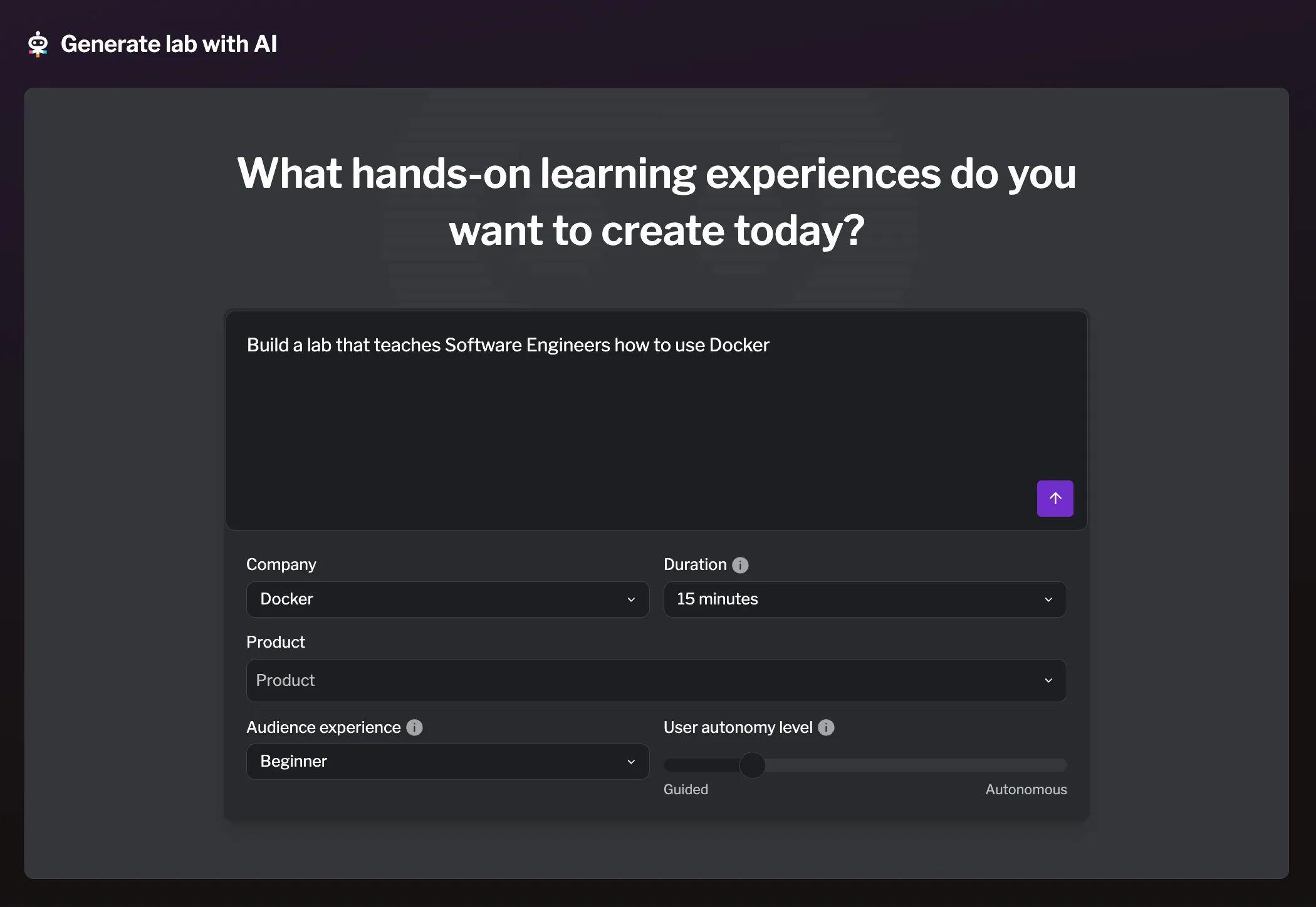
Fill in the form and click Generate:
| Field | Required | Description |
|---|---|---|
| Prompt | ✓ | A description of the lab you want to generate — what it should teach and, ideally, why. This is the main instruction the assistant works from. |
| Company | ✓ | The published company research to ground the lab in. This gives the assistant your business context, domain knowledge, and brand style. The list is populated from your published company research. |
| Duration | ✓ | Roughly how long the lab should take a learner to complete. Options range from 5 minutes to 4 hours; defaults to 10 minutes. This guides how much scope the assistant plans. |
| Product | One or more published products to focus the lab on. Populated from your published product research. | |
| Audience experience | ✓ | How experienced the audience is with the topic: Beginner, Intermediate, or Advanced. This shapes content depth, pacing, and assumed prerequisites. Defaults to Intermediate. |
| User autonomy level | ✓ | A slider from Guided to Autonomous. Lower values produce step-by-step, closely guided instructions; higher values give learners more freedom to explore and figure things out. Defaults to the middle. |
When you submit, Instruqt creates the lab and sets up an AI session, showing a short progress screen while it comes up with a name, provisions the assistant, and sketches an initial plan. It then takes you straight into the assistant, where the plan appears for your review.
How research grounds the lab
Section titled “How research grounds the lab”The company and products you select are more than labels — the assistant downloads your published research and uses it as context while planning and building. That’s what makes generated labs specific to your business rather than generic: the assistant draws on your terminology, tools, architecture, and best practices, and can use your real products as the subject of tasks and examples.
The more accurate and complete your published research, the better the generated lab. If you notice the output drifting from your product’s reality, that’s usually a sign the underlying research is worth revisiting.
What the prompt and settings influence
Section titled “What the prompt and settings influence”Everything you enter steers the generation:
- The prompt sets the subject and learning goal — be specific about what a learner should be able to do by the end.
- Audience experience drives difficulty, pacing, and how much prior knowledge the assistant assumes.
- Duration guides how many chapters and activities the assistant plans.
- Autonomy shifts the style between tightly guided walkthroughs and open-ended exploration.
See Best practices for guidance on writing prompts and choosing these settings.